Kevta
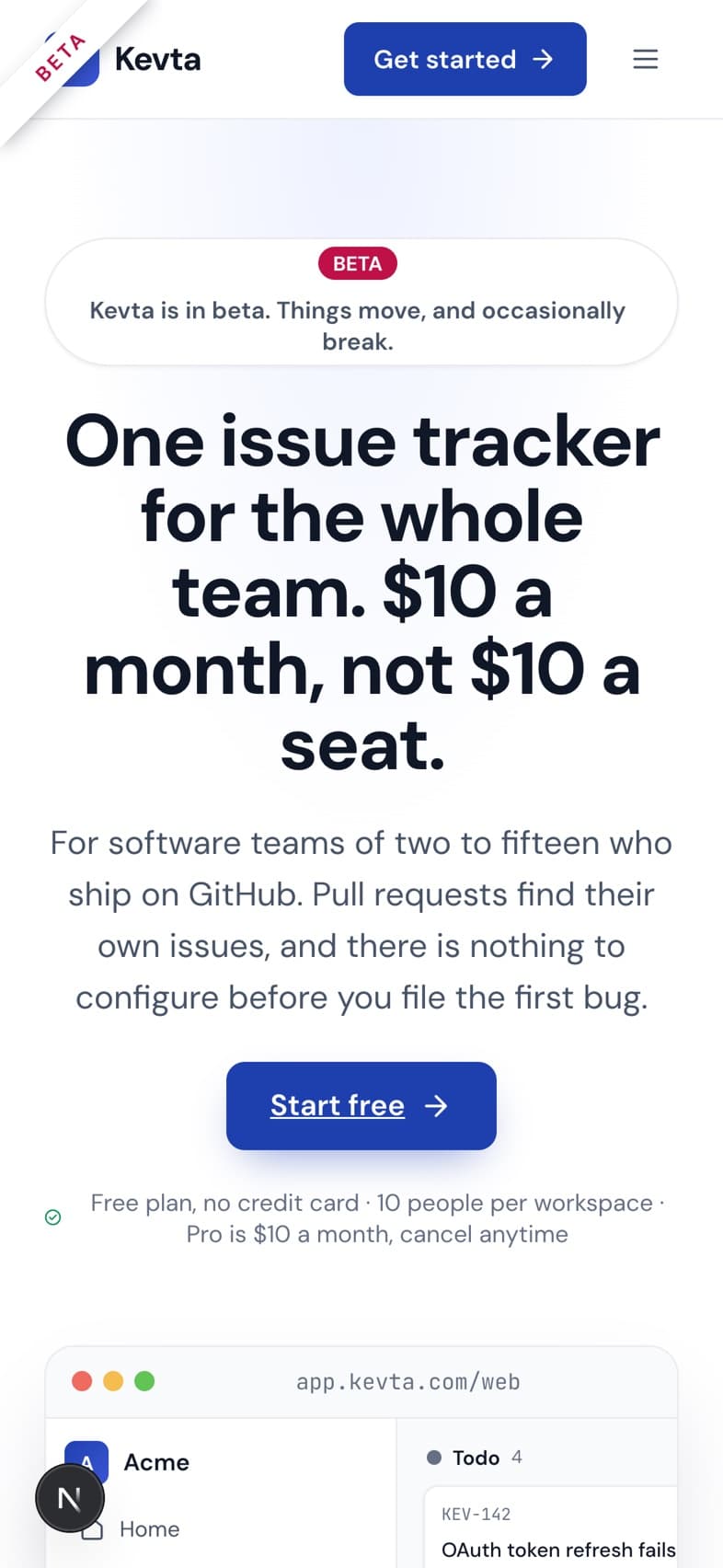
Kevta is Matrix Minds’ own product: an issue tracker for software teams of two to fifteen who ship on GitHub. We took it from product idea to a running, billable beta — design system, API, realtime app, payments and all.
kevta.appVisit the live site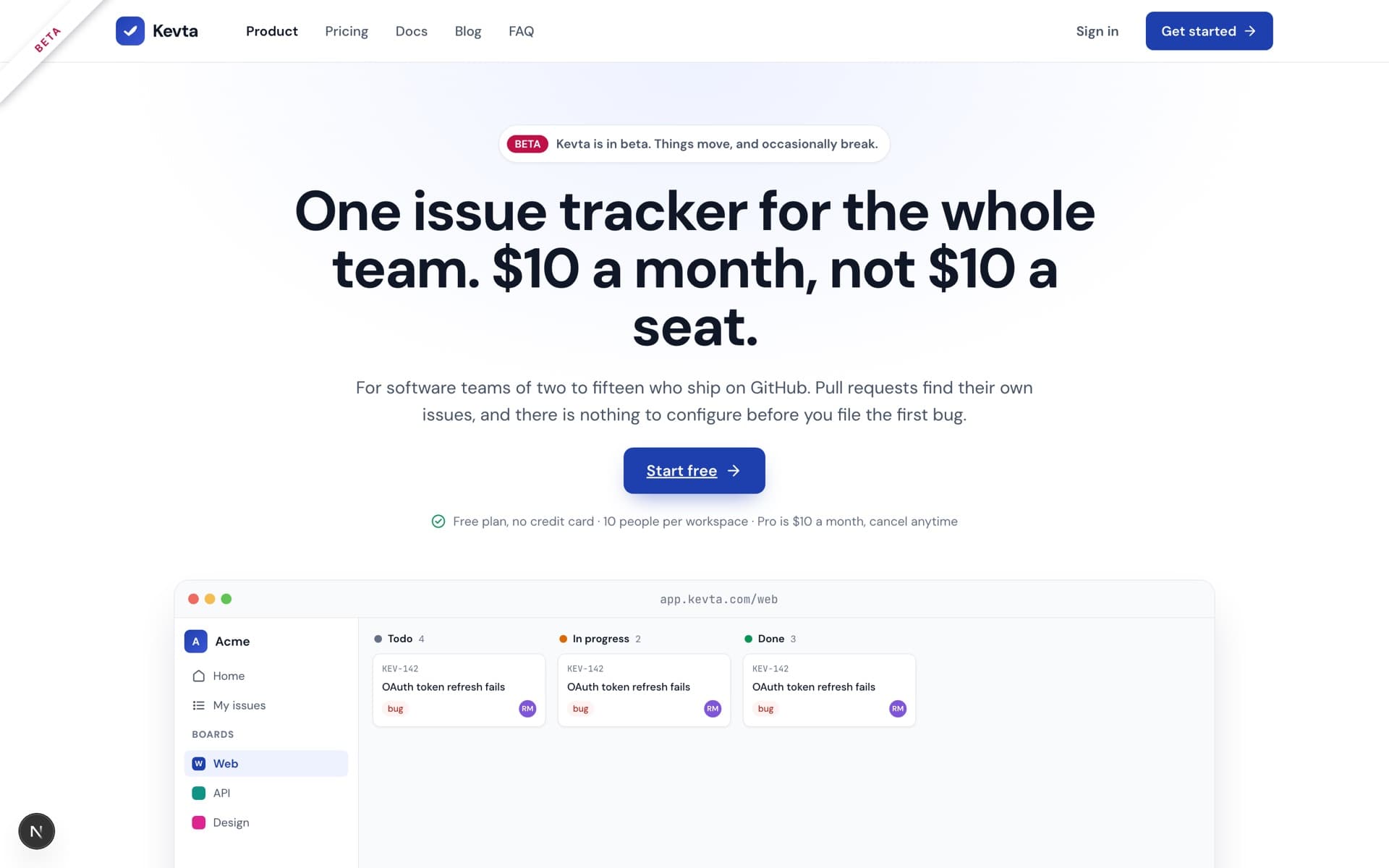
- Type
- Our own product
- Stage
- Beta
- Scope
- Product, design system, web app, API, billing
- Platform
- Web
The challenge
Small teams pick an issue tracker and then spend a week configuring it. Schemes, sprints, permission matrices and per-seat billing all arrive before the first bug is filed — and per-seat pricing quietly punishes teams for inviting a contractor or a founder who checks in on Fridays.
We wanted to find out whether a tracker could be opinionated enough to be useful on the first day, and priced so that adding a person is never a budget conversation.
The solution
Every board arrives with Title, Assignees, Status, Priority and Due Date already on it, and four views — board, list, table and calendar — that switch without losing context. There is nothing to configure before filing the first issue.
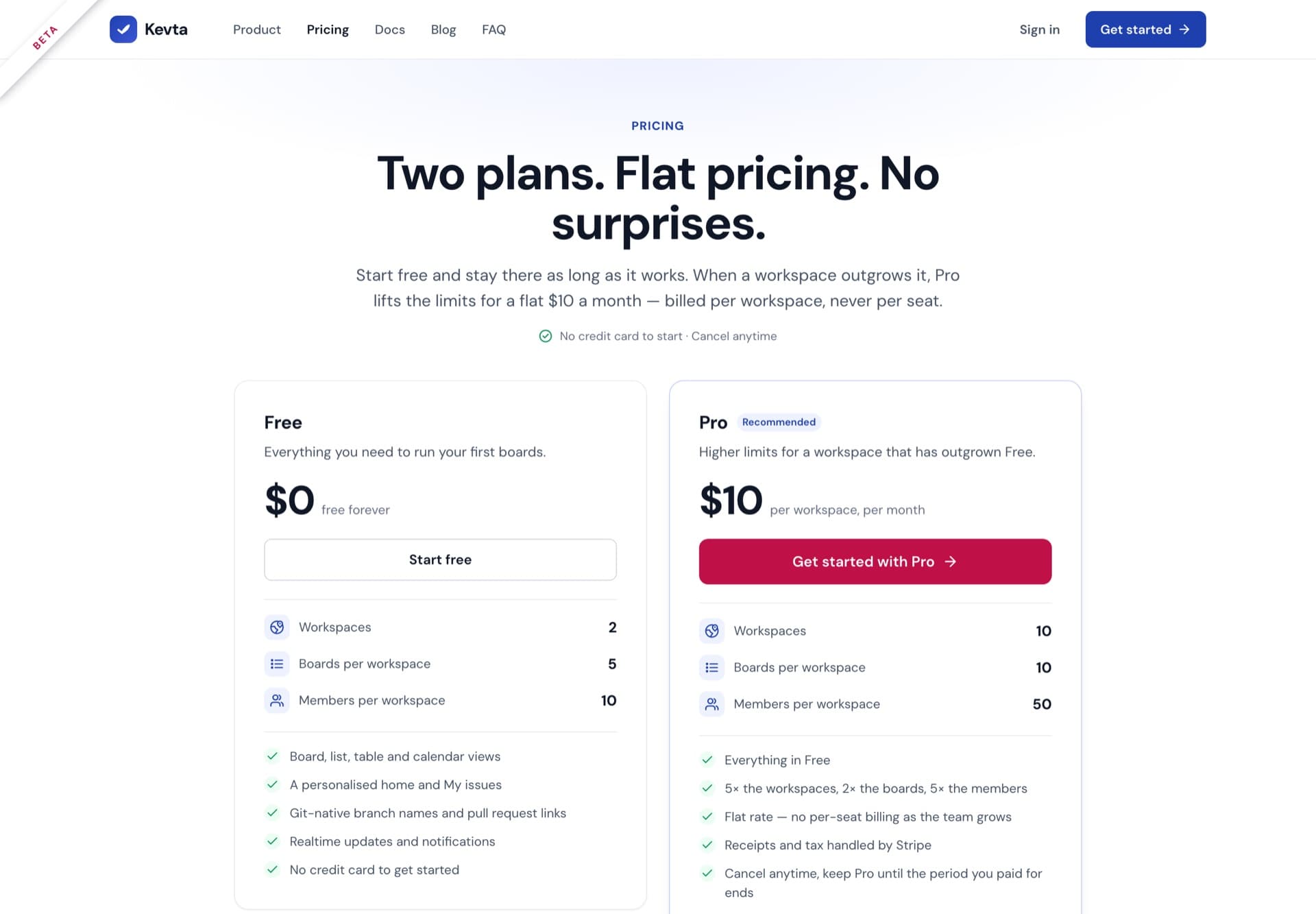
Billing is flat per workspace rather than per seat, which turned into a real engineering constraint: plan limits (workspaces, boards, members) have to be enforced server-side on every write, and Stripe has to stay in sync with them.
The Git integration is the part we care most about. Copy a ready-made branch name from any issue; when the pull request opens, Kevta matches it back by issue key with no linking step, and an automation rule can move the issue to Done the moment it merges.
Key capabilities
Boards, issues and four views
Board, list, table and calendar over the same data, with grouping, sorting and filtering per view.
A personalised home
Issues assigned to you, boards you pinned, recently-viewed boards and the activity you missed — instead of a generic task list.
GitHub integration
Branch-name generation, pull-request matching by issue key, and automation rules that move issues as checks pass and merges land.
Realtime collaboration
Socket.IO-backed live updates and notifications, so a board stays current without a refresh.
Workspaces and roles
Workspaces, roles and per-board membership keep the right people in the loop and everyone else out of the noise.
Subscriptions and plan limits
Stripe-managed subscriptions with plan limits enforced in the API — including receipts, tax and cancellation handling.
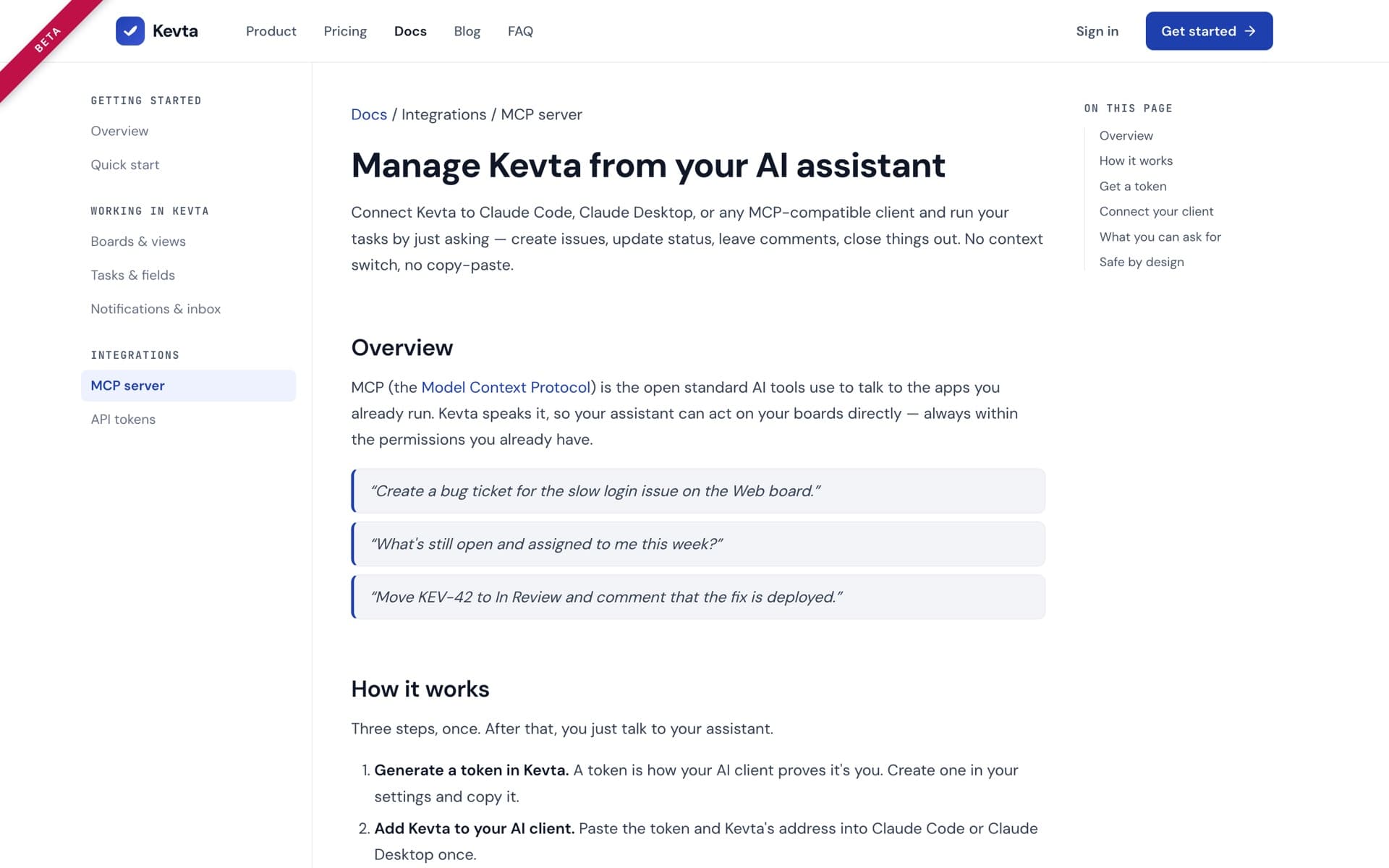
An MCP server
Kevta exposes a Model Context Protocol endpoint, so AI agents can read and update issues through the same authorised API as the UI.
Observability
Structured logging, Sentry error tracking and a documented API — the parts that make a product supportable rather than demoable.
Screens
Technology
- Next.js (App Router)
- React
- TypeScript
- Redux Toolkit
- CSS Modules
- Express 5
- Prisma
- PostgreSQL
- Redis
- Socket.IO
- Stripe
- Google OAuth
- Model Context Protocol
- Sentry
Confirmed from the project’s own codebase.
What we built
- A production Next.js application and an Express + Prisma + PostgreSQL API, running with Redis, Socket.IO, Stripe subscriptions, Google OAuth, structured logging and Sentry.
- A full design-system pass across the app: one component set, one type and colour system, a persistent app shell, and a rebuilt Home and Settings information architecture.
- A data-layer migration from MongoDB to PostgreSQL behind a stable API surface.
- Kevta is in beta. We are not publishing user or revenue numbers, because we would rather show the product than a chart.
Next case study
DifferegBilingual directory · Web platformHave a similar product in mind?
Tell us what you are building. We will tell you honestly whether we are the right team for it.